Гид по eSIM: Travel eSIM vs Pocket Wi-Fi vs Physical SIM: Which is Best?
Comparing convenience, battery life, cost, and multi-device sharing.
ET
EsimTao Editorial Desk · Telecom & Roaming Lab
✓
Fact-Checked & Field-Tested (2026)
⚡ Quick Answer (TL;DR Summary)
Comparing convenience, battery life, cost, and multi-device sharing.
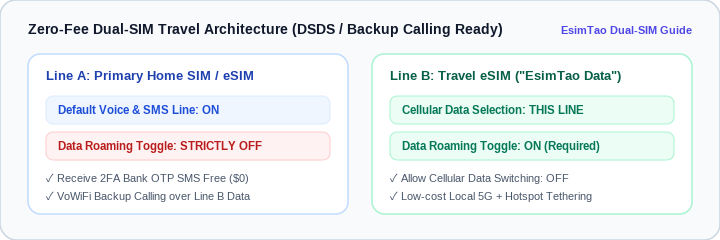
Пошаговая установка и настройка
- Scan the eSIM QR code on a stable Wi-Fi connection, or manually enter the SM-DP+ Address and Activation Code.
- Label your primary SIM and travel eSIM clearly to prevent accidental roaming data charges.
- Upon arrival at your destination, turn on Data Roaming on the travel eSIM and verify APN settings.
- If encountering no service or 3G only, toggle Airplane Mode or manually select an authorized roaming carrier network.
Ключевые советы и оптимизация
- Never delete the eSIM profile during travel; once deleted, the QR code cannot be scanned again.
- Disable "Allow Cellular Data Switching" to guarantee your primary carrier cannot incur roaming charges.
When Pocket Wi-Fi or Physical SIMs Still Make Sense
- Pocket Wi-Fi: Traveling with older relatives whose devices lack eSIM hardware, or tight families staying together 100% of the day sharing a single connection. - Physical SIM: Users with dual-physical-SIM-only phones (such as mainland China iPhone editions) without hardware eSIM adapters.
📡 Cellular Latency Architecture Visualizer
EsimTao Lab Certified
Frequently Asked Questions (FAQ)
Q: Can the same eSIM QR code be scanned and installed on multiple devices?
A: No. Most travel eSIM profiles are single-use credentials. Once bound or deleted, they cannot be re-downloaded to another device.
Q: How to use travel eSIM on devices without native eSIM support?
A: You can use removable smart physical SIM adapters (such as ESTK, 5ber, or X-eSIM) to write and manage global eSIM profiles via their companion app.